

THREAD & SILK, CHLOE GUSS: The Eco Fashionista
Do you ever think about where or how your clothes are made? Do you ever wonder why it is so cheap? After the collapse of Rana Plaza in Bangladesh in 2013, Founder of Thread & Silk, Chloe Guss decided enough was enough and wanted to improve the impact fashion has on the environment.

Do you ever think about where or how your clothes are made? Do you ever wonder why it is so cheap? After the collapse of Rana Plaza in Bangladesh in 2013, Founder of Thread & Silk, Chloe Guss decided enough was enough and wanted to improve the impact fashion has on the environment.
“Consumers need to become more conscious of the impact their fashion decisions make on the supply chain.”
“By no means am I moving the needle with my brand, but it is still a positive example of how you can be creative and help contribute to saving the planet.” Not to sound over dramatic but we are running out of water, resources and landfills due to our high rates of consumption. The American economy is based around one word: shopping. When we go through an economical crisis, what does the government tell us to do? Buy. Brands such as Zara and H&M are changing the way we purchase due to the rise of fast fashion and lower prices. But what is the true cost on the environment by implementing this economic model? (Hint: watch the documentary, The True Cost, to get the full background on how fast fashion is affecting the fashion industry).
“I didn't want to produce something that requires making new materials since the production of fabrics is very toxic to our environment.”
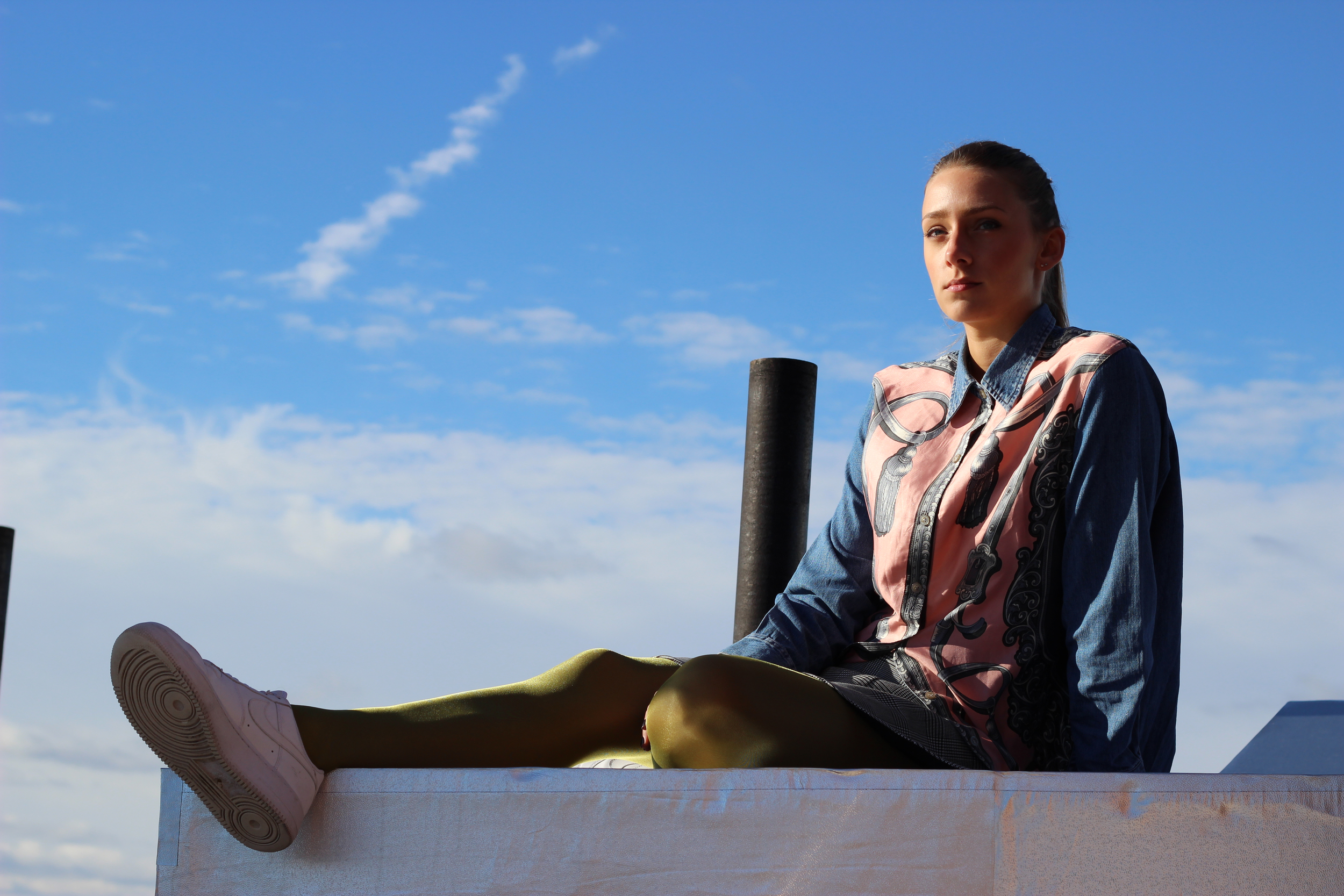
Built on the idea of not creating any additional waste, Thread & Silk is a fashion based company founded in October of 2013 that recycles old denim and vintage silk scarves to produce shirts for men and women. “I always wanted to create a product with a combination of a utilitarian fabric mixed with a high-end luxury fabric.” At a price of $150 per shirt, Chloe replaces the denim fabric with square vintage scarfs from luxury designers such as Hermès and Chanel. She then reuses the remaining denim material as a bag to deliver the garment in. Talk about zero waste!
“Thread & Silk came into being out of a series of circumstances.”
Chloe graduated from Tufts University in 2007 where she majored in American Studies. Consumed by wanderlust, she then took some time off to travel to Madrid for eight months to become an English teacher, took up a job in Boston for three years helping international students transit to the U.S. and then got lost for one year in the Sub-Saharan region of Rwanda working for Indego Africa. “I was always intrigued by artisans in the developing world. I had already traveled to Africa, Latin America and was always so drawn to local artist’s craftsmanship.” As a hopeless romantic dating a French man in Rwanda, Chloe decided to follow her heart and move to Paris. “During my time in Rwanda, I started working with a woman in Paris who had a young emerging brand in which she partnered with artisans in India and Tunisia. She was looking for someone to assist her develop products in Sub-Saharan Africa and I helped her create a line so that when I moved to Paris I would have something to do.”
The Aha Moment
New in town, Chloe’s first plan of action was to learn French! Just like Nasty Gal CEO, Sophia Amoruso, Chloe loves to hunt for vintage clothing and was constantly thinking of how she could make something different by the things she gets inspired by.
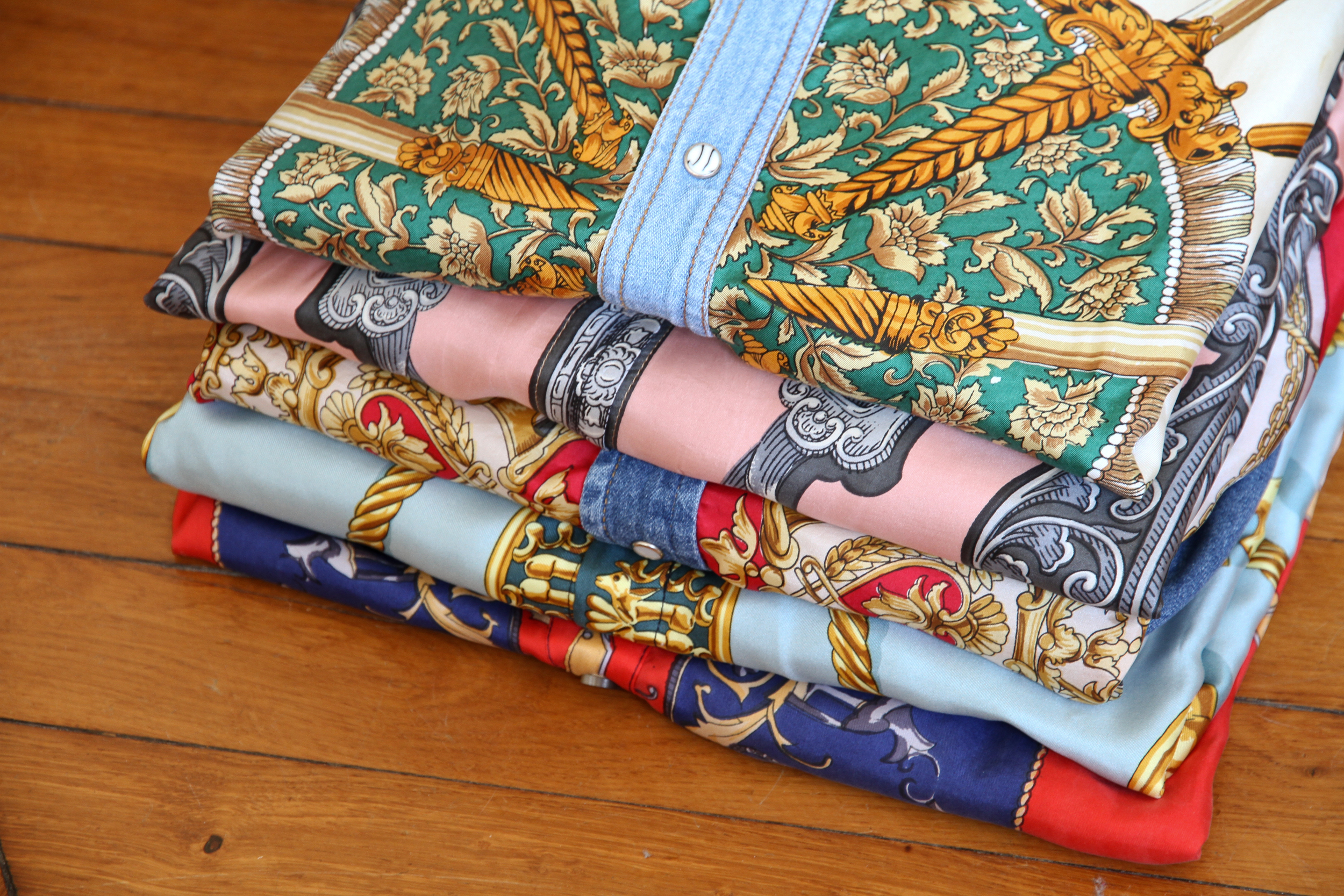
One Parisian afternoon, back in 2011, she stumbled upon a beautiful silk vintage blouse and thought “there are so many scarves that look just like this blouse. You know, scarves used to be an iconic piece in every woman's wardrobe, in every culture. It was then that I had this idea of turning them into blouses.” Since denim was making a big comeback, Chloe decided to combine the classes of the fabrics by mixing a utilitarian, casual property with a sophisticated iconic one. “Both of these fabrics have a lot of history to them and like two sides of a coin, they represent both the upscale and lower scale of fashion.”
Why The Name

“The name was inspired by the materials. I liked brand names with two words with an “&” sign such as Rag & Bone and Alice & Olivia. I used the needle and thread because it shows something that has been reworked and goes with our tagline which is refound, reworked, reinvented.” In the beginning, it was called Thread & Sequence because Chloe was extremely obsessed with sequences, but later thought it sounded juvenile and wanted something more sophisticated. Hence, Thread & Silk was born.
“It took me a long time to get things off the ground. I got really tangled up in wanting everything to be perfect before I had even sold one shirt.”
Chloe tells us how she has faced a lot of challenges when starting her company. “Because the shirts are one of a kind, each fit and size is different and that is something I have struggles with, especially from an e-commerce point of view. However, the biggest challenge I have had is working alone.” Being cash poor as a company, Chloe has had to rely on her friends to call in favors. As business women ourselves, we know the importance and gift of having the opportunity of working with a co-founder.

Founder, Chloe Guss in Paris
RADICHE GUIDE: The Importance of having a Business Partner:
Helps move the business along faster (divide and conquer)
Holds you accountable
Gives you more financial options than self-investing
Provides open communication for brainstorming
Adds new skill sets that you may be weak in
Chloe is currently pursuing a Master’s degree in Strategic Design and Management at Parsons, specifically to learn the management skills needed to develop her company further.
Are you driven and motivated by sustainability with a love for fashion? Contact founders@radiche.com and we'll put you in touch with Chloe to potentially join her team and help her grow the business.
Photo courtesy of Thread & Silk.

NEGATIVE, LAUREN & MARISSA: No Boob Gets Left Behind
In a world of frills, lace and overdone trims, Co-founders Lauren Schwab and Marissa Vosper want to bring the S back to simple and sexy in the lingerie space. Having launched in 2014, Negative’s belief of “less is more” is a reflection of both their price points and brand attitude.

In a world of frills, lace and overdone trims, Co-founders Lauren Schwab and Marissa Vosper want to bring the S back to simple and sexy in the lingerie space. Having launched in 2014, Negative’s belief of “less is more” is a reflection of both their price points and brand attitude.
“We believe that the shopping experience offline for lingerie today is rather broken, and so we are hopeful that we can streamline it and give one the opportunity to try it on in their living room.” Priced between $35-$200, Lauren and Melissa wanted to make high-quality lingerie but also have it be accessible for women to purchase online. By removing the middle man, Negative has managed to keep its price points lower than its competitors such as La Perla and provide a collection for everyday usage. Not to mention, their products are extremely comfortable, perfect for those long flights or for times when you accidentally lock yourself out (yes, we own a pair).
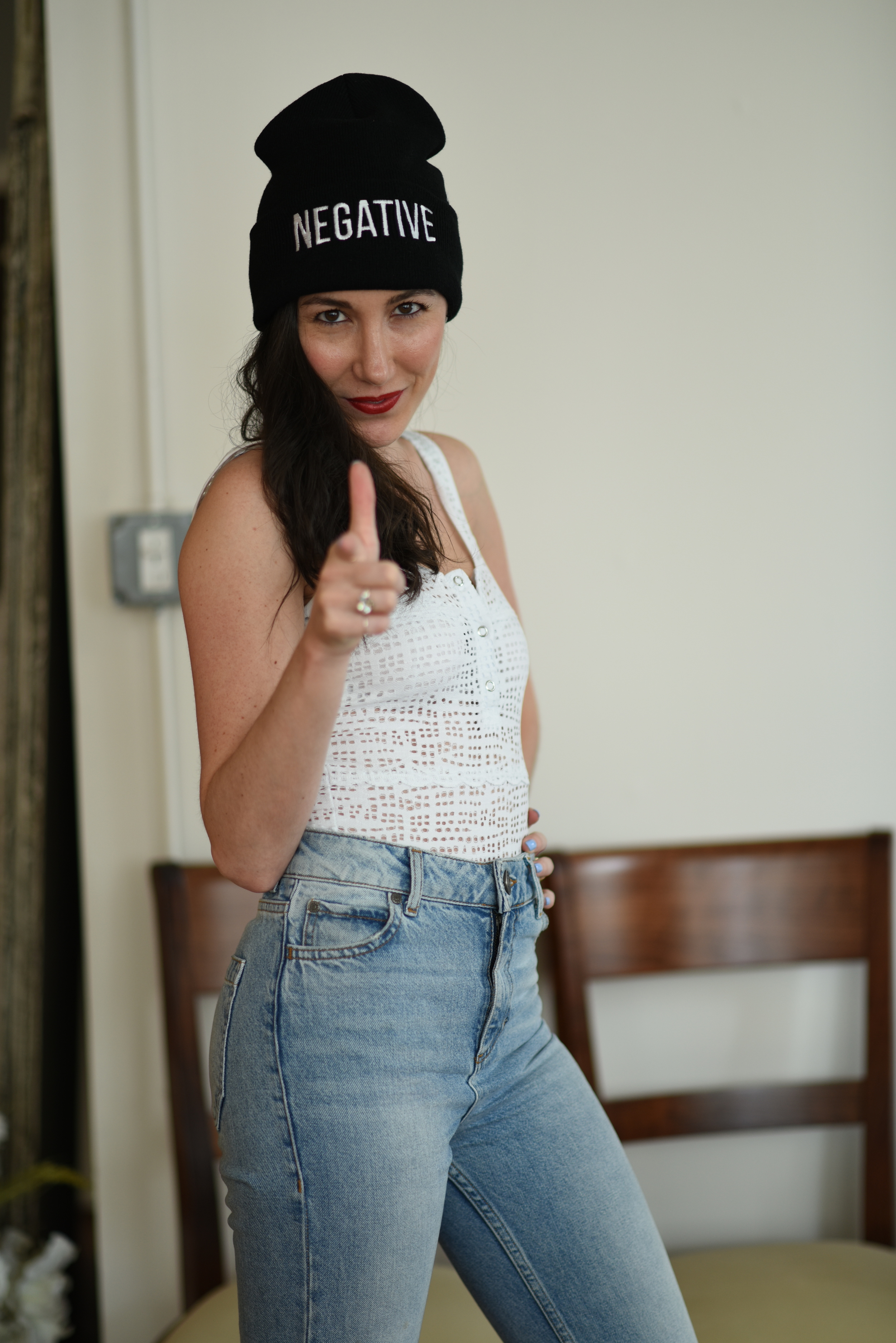
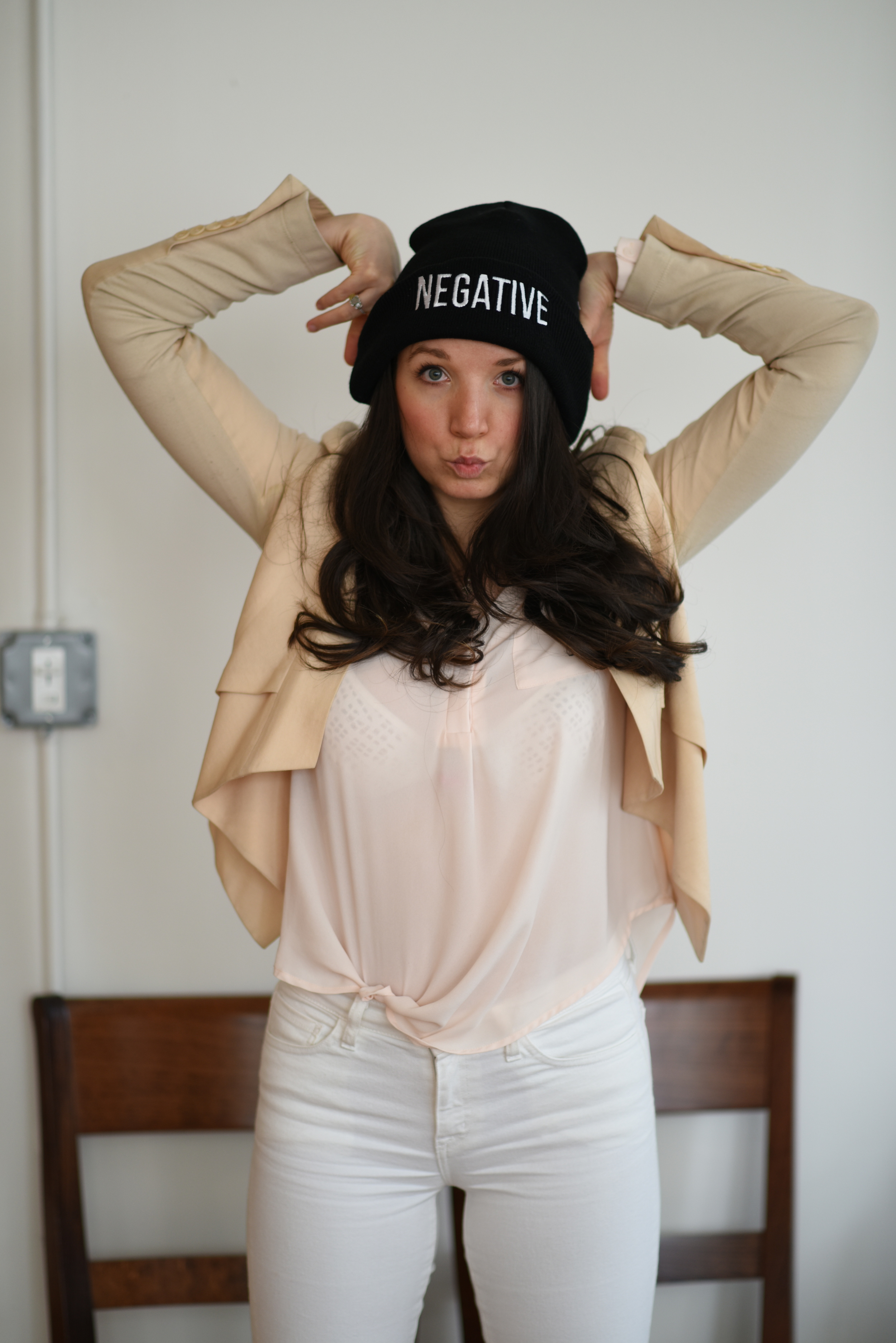
Freshman besties from the University of Pennsylvania, Lauren and Marissa had no prior experience in the fashion world. Lauren majored in Art History and Diplomatic History while Marissa explored Politics and Spanish. Upon graduation, Marissa worked as a Brand Consultant for agencies and Lauren joined the dark forces by entering a private equity firm.
While you might be wondering, there wasn't really an “aha” moment for Negative. The idea came about while sitting at lunch with their girlfriends around the age of 26, discussing what the next steps for their lives were and how they didn't want to continue working a corporate job forever. Like most of us around this age, they were rethinking life.
“Our brand is all about taking away the unnecessary”

With no previous experience in fashion, “we decided to take classes together at FIT and it wasn't necessarily with the intention of ‘let’s do this’ and start a business immediately, but more from the mindset of we’re two smart women, and we love fashion, maybe there is something we can think about doing differently than just going and getting a job in an existing business.” By enrolling in classes together, they understood how they both worked as partners and as individuals. “Our time together in classes solidified that we both had a similar vision of why we wanted to do this and our aesthetics are very aligned so it made it very easy. We certainly weren't lingerie enthusiasts before we started. I think we spent most of our time in class and on the weekends exploring opportunities in markets where we felt there were innovative businesses and a white space. It’s funny, we’re all very brand loyal to the things that people can see but not to our undergarments and we thought that was a huge opportunity.”
Divide and Conquer

Coming from a branding background, Marissa is the guru behind the brand ethos and strategy for Negative while Lauren heads product development. Fun fact: Lauren’s family is fourth generation in designing and manufacturing children's wear. ‘I didn't want to go back and work for the family business because I didn't see a white space in that market. I don't have kids, but I wear lingerie and it just seemed natural to go in that industry because I was the target audience.” Working two jobs until the launch in 2014, Lauren explored the product development stage for three years and tells us how complex and technical the development of lingerie is. “We basically looked at our network and said who do we know, who can we ask questions to because at the time there were no books on how to make lingerie. You had to talk to people in order to learn how to make the product. So we asked a million questions which eventually led to finding our manufacturer in Colombia.”
As for the packaging, it was inspired by a Lacoste shirt, which was vacuumed packed and allowed you to see the shape. “We loved that idea and went with our current silver foil packaging. It is simple and also helps maintain our inventory efficiently.” (Talk about space saver!)
“Originally we had created the brand with ourselves and our taste in mind, but our target market has evolved. We haven't tapped into a certain demographic, but a psychographic where women range from teenagers to 80 years old. Some of our most loyal customers are in their 50’s.”
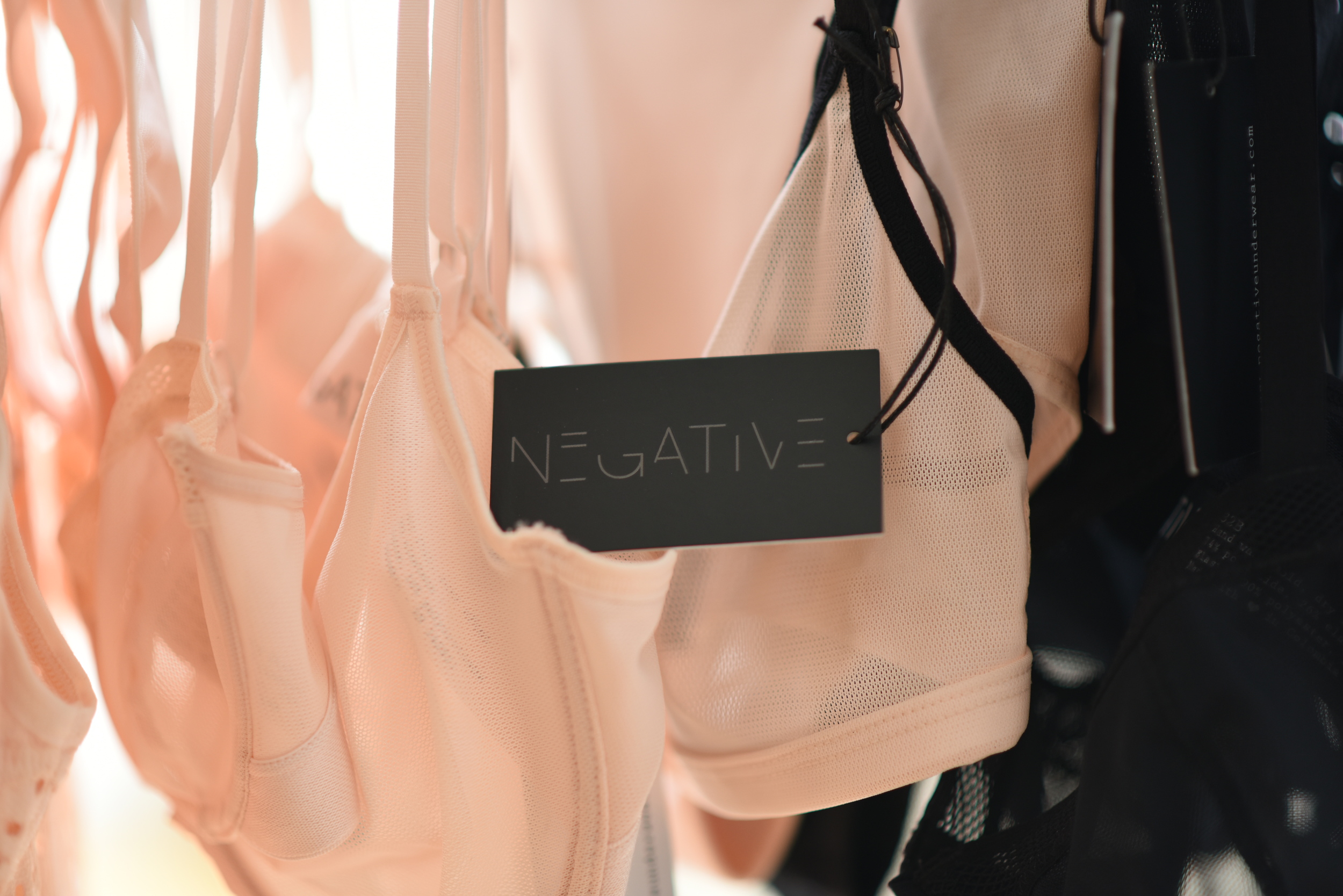
Before launching, Negative conducted focus groups and invited friends of all shapes and sizes, breasts and thighs. Not wanting anyone to feel left out, they started a campaign called “Support The Girls” to create a movement that helps women feel comfortable with their body instead of constantly criticizing it. “It’s about them dressing for themselves instead of their boyfriends, husbands, and significant others. It was extremely successful and we hope to continue to make it bigger.”
Negative’s exposure in numerous publications such as the Wall Street Journal before Valentine’s Day in 2014 also helped boost their brand and increase sales. Despite selling online, the brand is also available for purchase by appointment in their rad SoHo showroom. However, their most successful marketing channel has been Instagram as it is a good way to express the brand voice and vibe. Negative also engages in email marketing, which is a growing channel as well as conducts events (pop-up truck) around the city.
Their Piece of Advice:
Go for it - you won’t know what to do until you actually do it
Do your research
Leverage your network, you never know what comes out of conversations
In the future, the ladies hope to expand the product line and have already released their t-shirts and bodysuits. If you’re looking to get in touch with them, want to collaborate or just say hi, contact us at founders@radiche.com

MENSWEAR DOG, YENA KIM: America's Next Top Model
The internet famous Shiba Inu dog who took fashion brands by storm, Bodhi is not your typical model. What started out as a fun activity for fashion designer, Yena Kim, went viral and helped launch her career as a photographer.

With the rise of social media, there are more breeds of fashion celebrities than ever, from makeup influencers to vloggers. And as some particularly fluffy breeds gain legions of followers, it looks like fashion could be going to the dogs.
Though it sounds strange to say, by now many of us are familiar with the celebrity known as “Menswear Dog.” Photos of the now internet-famous Shiba Inu, named Bodhi, wearing mens’ clothing first broke the Internet back in 2013. But what (dog owners, including us, might wonder) led to that first pivotal post?
One rainy Saturday afternoon, Bodhi’s cosmopolitan and fabulous parent Yena Kim was sitting at home bored. She and her husband, Dave Fung, had just watched Fantastic Mr. Fox and agreed that the fox looked a lot like Bodhi. “We had a couple of shirts lying around, so we thought, ‘Why don’t we do a snapshot?’ I thought Bodhi would run away and we would laugh over it, but when we put the shirt and collar on him, he started giving us these angles and poses. It was almost as if he was smiling. We took three photos of him in different outfits and posted one of the images to our personal Facebook. It got more likes than Dave or I had ever received!”
Everyone was like “Oh, this should be a thing!”

Feeding off the public's response, Dave—as a graphic designer does—quickly put a logo together for Menswear Dog and uploaded the images to a Tumblr account that Sunday. Monday came around and the next thing they knew the Menswear Dog website was blowing up. GQ and other big publications such as The New York Times even picked it up. “We were both working full-time jobs during that time but we were getting requests to come in for shows and receiving opportunities that we never had before. We ran out of sick days in April 2013, so we had to make a choice if we were going to pick the site over our other work. It was very scary, but really exciting at the same time. I felt that if I didn't do it, I would really regret it and that is something that I wouldn't be able to live with.”
The Team
With no previous experience in photography, Yena is known as the main woman behind the camera. “I would Youtube how to do things and ended up launching my photography career through Bodhi, as my muse.” Always creative, Yena had studied graphic design at Rochester Institute of Technology (RIT) for a year and a half, where she met Dave. But, as she says, “I like doing things with my hands and found the screen very limiting.” So she took a gap year to teach English in Korea, where she saved up enough money to attend the Fashion Institute of Technology (FIT) in New York and study Fashion Design.

As an international in this market, Yena realized that she would have to be one of the best if she wanted to stay in the country post-graduation. “During my time at school I interned at a bunch of places because, as you know, it is harder for our generation to get a job when we graduate due to the saturation of the market. After graduation I was working with Ralph Lauren for two years in their design team doing beading, trim and dresses. I think Dave and I were both still dreamers, but our jobs did not allow us to live it out that much. We were both very creatively frustrated at the time.”
“Don’t look at what has been done previously. Go for what is happening right now and use the Internet to grow your reach.”

As a Fashion Designer, Yena feels that schools under-prep students for the reality of the fashion world. “Most students feel that they are not ready until they graduate, but they should start working on something while they are in school, even if it is just a blog.” With social media today, “designers can have their own voice and feature their designs on their own platform. So the power goes to them because the public ends up following the designer more so than the brand.”
“It was a way for us to take a risky adventure”
Today Menswear Dog has over 255K followers on Instagram, 210K likes on Facebook and over 224K followers on Tumblr. Brands such as Coach, Salvatore Ferragamo, Jimmy Choo, Banana Republic and Ted Baker (to name a few) have jumped on the viral bandwagon to use this unusual model as a way for them to market their collections. “We have never reached out to brands. We have always had them reach out to us. Instead, we concentrate on making sure that our content is interesting. We try to make it viral but that’s never the goal. At the end of the day, you will get their attention if you have an amazing post and people are sharing it.” Just goes to show that attention to content quality pays off! Literally.

In April 2015, Yena and Dave published a coffee table book for Menswear Dog. They wanted to create a classic, timeless book that could help men build the backbone of their wardrobe with a very simple overview. “Using a dog takes the intimidation out of fashion, which I think a lot of men struggle with. It is because he is a dog, not a man or a woman, or any race or age, that the fashion he shows becomes neutral and easy to relate to.” Yena even plans to develop Menswear Dog into a pet brand in the future—so stay tuned, furry friend lovers.
Interested in meeting Bodhi or getting advice from Yena for fashion design? Email founders@radiche.com and we’ll put you in touch.
SABAH, MICKEY ASHMORE: The Rise of a New Salesman
Meet the Sabah Dealer. His passion, authenticity and love of building relationships has created a cult following for Sabah—not your typical retail business, or your typical shoe.

Meet the Sabah Dealer. His passion, authenticity and love of building relationships has created a cult following for Sabah—not your typical retail business, or your typical shoe.
Suave and charismatic, Mickey Ashmore, the man behind Sabah and its popularity, is a creative entrepreneur with an inherent knowledge of how to connect with people. His adventurous, welcoming and curious attitude—along with core business and analytical skills—are the cornerstone of the success that the Sabah House has experienced since its inception in 2013. Starting as a pure fashion statement, Sabah has now transformed into a lifestyle brand with the help of a few friends.
“Sabah Sunday is going to be the best Sunday anyone has ever had with the best wine, best food, best crowd and best shoes”
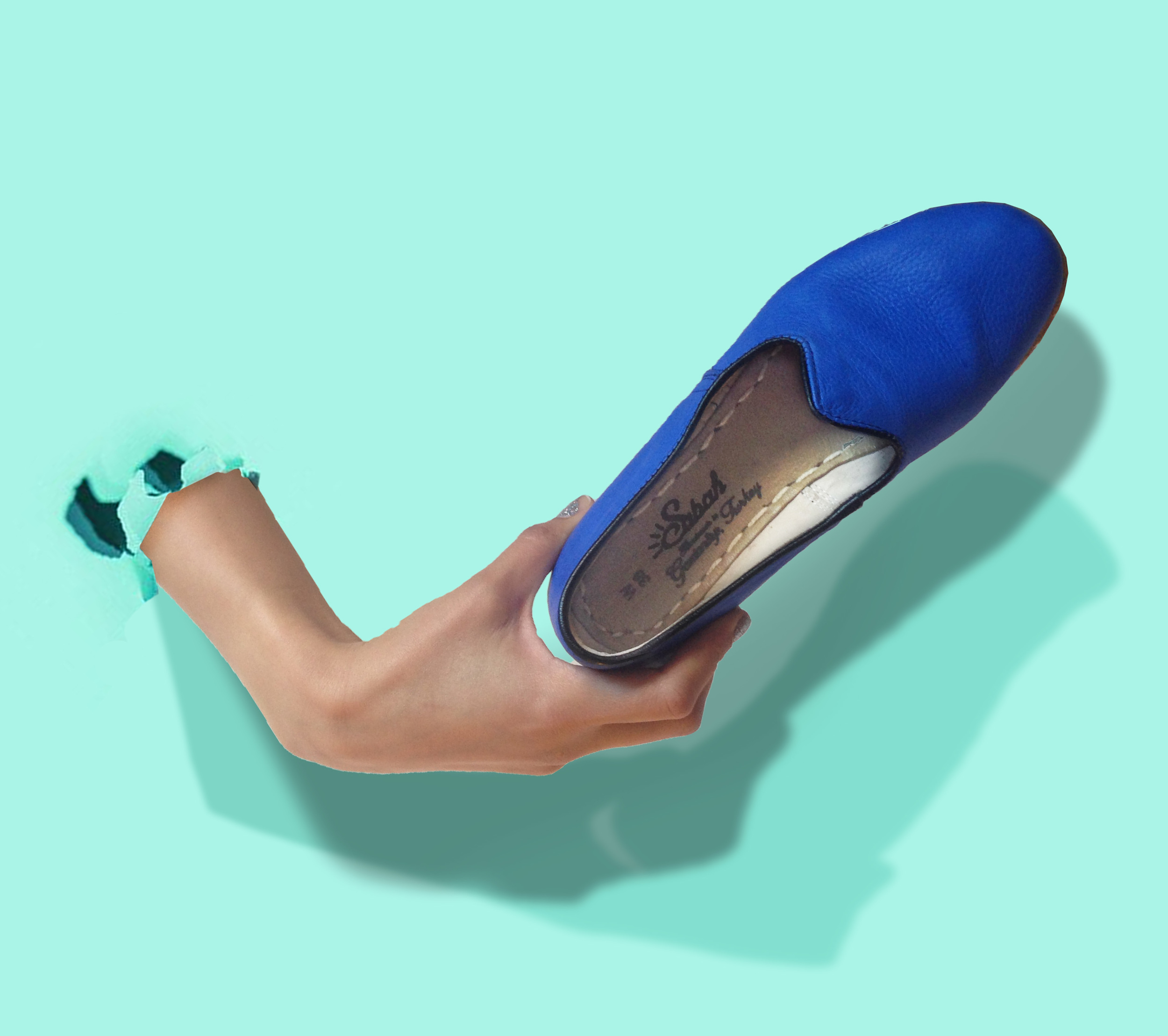
Sabah was born after Mickey returned from Istanbul, where he lived and worked for Microsoft for a couple of years. During this period, he was dating a Turkish woman and was introduced to the Turkish culture; he is also fluent in the language (not bad for a Texan!). At a marketplace in southeast Turkey, the seeds of Sabah were planted when he was gifted a pair of genie-style slippers, called chark. Absolutely in awe of their comfort and style, Mickey wore them everywhere when he returned to the U.S. and we mean everywhere (he even attended a wedding in them and no, he did not look like Aladdin). When the time came for a new pair, he was able to locate a group of Turkish artisan shoemakers, request some changes to the original shoe and order several pairs of his personal design. The whole process, which took about six months, was “fun” for Mickey. Little did he know, he was on his way to starting a shoe business.

At the end of six months, Mickey named his personally designed shoe, sabah, which means "morning time" in Turkish. He loved the idea of a shoe that people could slip on in the morning and not take off till the end of the day. Once he had a large order of Sabahs shipped from Turkey, Mickey decided to throw a party and see if other people would love them, too. After a majority of the shoes sold that day, Mickey decided to go back to Turkey, get more Sabahs and start hosting "Sabah Sundays" in an open house sales environment, rather than be hung-over in bed like the rest of us. A few successful Sundays later, he was ready to quit his job and fly to Turkey to perfect his Sabahs.
“Sabah lives and dies by the relationships we have created”
As we said earlier, Sabah is not your typical retail business. The Sabah House, Sabah’s townhouse headquarters in New York’s East Village, operates to the likes of a hotel, welcoming buyers and friends of Sabah to an atmosphere more akin to a social salon than a store place. As Mickey says, "We are a small business that makes shoes in a very old-school way….Our customers are treated as guests and we run lots of dinner parties! We get to know our customers, their stories and their preferences. We are building relationships similar to those one would whilst running a hospitality space." With this ethos in mind, the Sabah team has literally made it their business to make people feel good à l’hotel Sabah as they shop and mingle.
Despite the norms of the fashion industry, Mickey has taken a very unique approach to marketing. They don’t sell their products online. Instead they host events, engage in social media, use email marketing and on the road branding via pop up shops (he likes to travel to Los Angeles & Texas, ladies). As a result, Sabah has grown primarily due to word of mouth. In fact, one of the most important guiding principles was inherited from a customer’s view of the Sabah business: “Sabahs are bought, not sold.” Shout out to Mark Merken for coming up with that!
Instagram has also helped curate a lifestyle around the brand. With usage of a trending hashtag, “#WhereToNext,” Sabah has managed to gain a large following. Although, when asked on his thoughts regarding the platform, Mickey says, “I value Instagram as a business tool, but I think it takes us away from what is real. At Sabah, we work really hard but only show the leisure side of our brand, similar to many brands on the platform. However, a big day of work for our team is when we are all, including myself, filling boxes with shoes but we don’t seem to post pictures that tell the behind-the-scenes story. Sitting by a pool is not aspirational. I think it is the people that work hard and are change agents that inspire us." We couldn’t agree more!
The Inspiration

When we asked Mickey what has truly inspired his creative genius, he named family, friends, travel and the Sabah customers as his biggest muses. “My grandfather sold cars, my father sold shoes, and my mother ran a travel agency. I was fortunate to inherit my love for wanderlust and people through my mother, who knew how to connect with them deeply. My father instilled the power of marketing and sales in me.”
And it seems the two loves Mickey learned from his mother are intertwined. As he points out, “My favorite part about traveling was the people I met—it is the only thing I remember from my trips.” Another fascinating aspect of traveling, studying and living abroad was that he was always stimulated seeing something new. So, in his words, even “going to the dry cleaners was exciting!” We now know why the Sabah house has become a sanctuary for nesting, shopping and enjoying interesting company.
How to run a passion business? “Just go for it”
Like many Millennials, Mickey was constantly toying with ideas and starting ventures. His past resumé includes importing women’s swimwear and lingerie, and a few other wholesale businesses. In his words, “As Nike said, just do it. I had a million ideas and I just did it. If one did not work, I moved on to the next one.” With Sabah, he recalls, “There was no white paper strategy to our business plan, it was a true reflection of myself. I don’t shop online and was always bringing people together. Sabah shows authenticity.” Basically, make something you’d want yourself.
Ups and Downs
Though the business is doing really well, Mickey doesn’t pretend he hasn’t faced obstacles and challenges in the past. As one would expect with a retail business, production was extremely difficult to streamline while organizational structure was “the hardest thing to do” for Mickey. His advice: "Don't overly structure things; build the business first and retroactively structure it as you go."

How would you want people to remember you? “He brought good energy to the world”
Next time you are in the East Village, make sure to stop by the Sabah House. Better yet, plan to attend Sabah Sunday and enter their home/hotel/safe space (whatever you’d like to call it) to meet Mickey and his super personable team. Let yourself be carried away to Turkey with the smell of musky oud and beautiful décor—all while shopping for the most comfortable artisan shoes around. Let them know we sent you over :)